

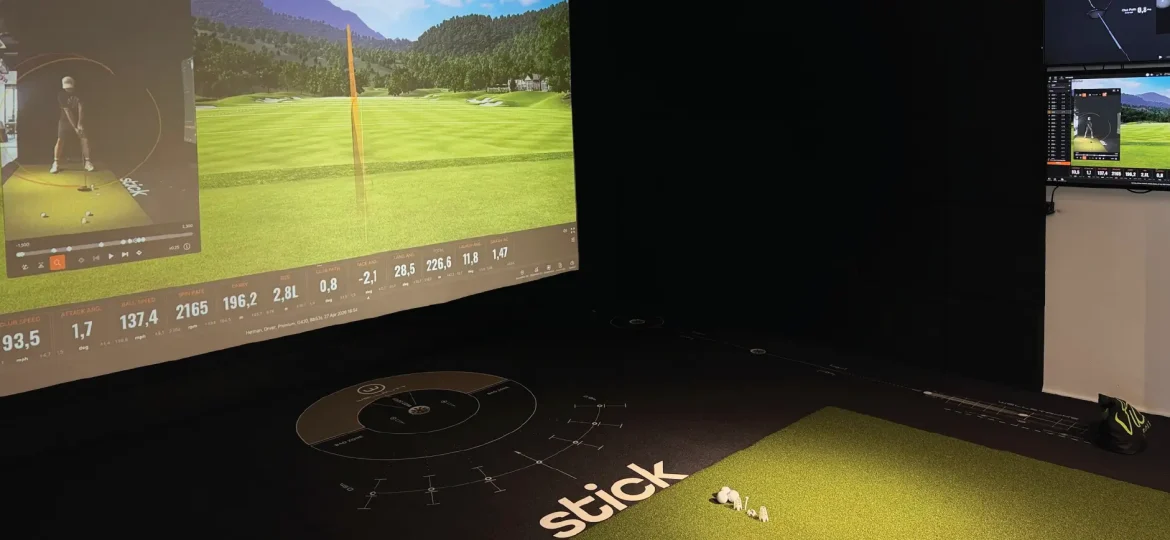
Most golfers hear “TrackMan” and think of tour players, orange boxes and serious-looking numbers on a screen.
Fair.
But during a fitting, the point is not to look clever.
The point is to answer one simple question:
Is this club helping the player produce better golf shots?
Not one good shot.
Not one loud ball speed number.
Not one heroic swing that deserves a small parade.
A repeatable pattern.
That is the bit that matters.
TrackMan measures what happened. The fitter explains why it happened. Then the club gets tested against the player, not against a shelf label.
TrackMan Does Not Fit Golfers. Fitters Do.
This matters.
The machine gives numbers.
The fitter gives meaning.
A launch monitor can show:
- the ball launched too low
- spin dropped too far
- strike moved heel-side
- dispersion opened up
- the clubface arrived differently
- carry distance changed
- the shaft changed timing
- the head changed launch and spin
But numbers do not make the decision alone.
A good fitter reads the pattern and asks:
- Is the strike improving?
- Is carry more reliable?
- Is dispersion tighter?
- Is launch in a better window?
- Is the club easier to deliver?
- Is the player getting a result they can repeat?
That is fitting.
Not “this number is bigger, so this club wins.”
That is spreadsheet golf. Nobody needs that.
The Main Numbers And What They Mean
| Metric | What it tells the fitter |
|---|---|
| Ball speed | How efficiently energy gets into the ball |
| Launch angle | How the ball leaves the face |
| Spin rate | Whether flight has enough stability and carry |
| Carry distance | Useful distance before rollout gets involved |
| Dispersion | How tight or wide the shot pattern is |
| Club path | Direction the club travels through impact |
| Face angle | Where the face points at impact |
| Face-to-path | Why the ball curves |
| Attack angle | Whether the club travels up, down or level into the ball |
| Dynamic loft | Delivered loft at impact |
| Smash factor | Strike efficiency |
| Impact location | Where the ball meets the face |
The trick is not memorising the table.
The trick is knowing which number matters for that player, with that club, on that day.
Golf loves context. Annoying, but useful.
Ball Speed: Not The Same As Swing Speed
Swing speed gets the attention.
Ball speed tells a sharper story.
Ball speed shows how much energy transfers into the golf ball at impact. A player can swing faster and still lose performance if strike quality drops.
Clean strike beats noisy effort.
In a fitting, ball speed helps show whether a clubhead, shaft or setup helps the player find the middle more often.
That is why a player can sometimes gain distance without swinging harder.
The club starts delivering the ball better.
Less theatre. More output.
Launch Angle: Where The Shot Starts
Launch angle shows how the ball leaves the clubface.
Too low and the ball struggles to carry.
Too high and the flight can lose power.
The right launch depends on:
- club
- speed
- strike
- loft
- attack angle
- spin
- player delivery
This is why copying another golfer’s loft setup turns into expensive guesswork.
A 9° driver can be perfect for one player and completely wrong for another.
The number on the sole is only the beginning.
The delivered result is the truth.
Spin Rate: The Misunderstood One
Golfers love saying “low spin” as if it has never caused trouble in its life.
Low spin can help.
Low spin can also make the ball fall out of the air like it remembered another appointment.
Spin is not good or bad on its own.
It needs to match:
- launch
- speed
- strike
- shot shape
- club
- player goal
Too much spin can cost distance.
Too little spin can cost carry and control.
A proper fitting finds the spin window that helps the player, not the one that sounds impressive in a WhatsApp group.
Carry Distance: The Honest Distance Number
Total distance can be messy.
Rollout depends on:
- fairway firmness
- slope
- weather
- landing angle
- spin
- course conditions
Carry distance gives the fitter a cleaner read.
It shows how far the ball travels through the air before the course starts adding its own little opinions.
For irons, carry matters because gaps matter.
A 7-iron that flies 145 metres one swing and 157 metres the next is not giving the player a proper tool. It is giving them a guessing game with a grip on it.
Good fitting builds useful distance.
Not random distance.
Dispersion: The Number That Saves Rounds
Distance sells clubs.
Dispersion saves scorecards.
Dispersion shows where shots finish as a pattern:
- left/right spread
- short/long spread
- start direction
- curve
- consistency
This is where a fitting gets serious.
A driver that carries 8 metres farther but spreads 25 metres wider has not automatically won.
A slightly shorter club with a tighter pattern can be the better weapon.
That does not sound as glamorous.
It does sound like fewer punch-outs from under trees.
Club Path And Face Angle: Why The Ball Curves
Ball flight has reasons.
Club path shows the direction the club travels through impact.
Face angle shows where the clubface points.
Face-to-path explains curve.
That helps separate old-school guessing from proper diagnosis.
Instead of saying:
“You came over it.”
The fitter can say:
“The face was open to path, and that is why the ball moved that way.”
Cleaner.
Less folklore.
More useful.
Impact Location: The Quiet Snitch
Strike location changes everything.
A ball hit high toe, low heel or dead centre can produce completely different:
- ball speed
- launch
- spin
- curvature
- carry
- feel
This is often where fittings get interesting.
A player may think the shaft is the problem.
Then the impact pattern shows low-heel strikes again and again.
Now the fitter has a proper lead.
Not a guess.
Impact location tells on the club, the setup and the strike pattern.
Tiny mark. Big evidence.
A Simple Fitting Example
A player comes in with a driver.
Current pattern:
- carry: 218 metres
- launch: too low
- spin: too low
- strike: low on the face
- miss pattern: right side
- total distance looks decent on one or two shots
- average pattern is not stable
The old answer:
“Swing better.”
Helpful as a wet scorecard.
The fitting answer:
Test more loft.
Test a shaft profile that helps timing.
Test head options that improve strike and spin.
Watch carry, launch, spin and dispersion together.
The win is not one ball going 250 metres.
The win is a tighter pattern with better carry and a flight the player can trust.
That is what TrackMan helps reveal.
What Good Fitters Do With The Data
Good fitters do not drown players in numbers.
They use the right numbers at the right time.
The process normally looks like this:
- Test the current club first.
- Find the baseline pattern.
- Identify the main performance issue.
- Change one variable.
- Compare the result.
- Keep what improves the pattern.
- Remove what only looked good once.
The “one variable” part matters.
New head, new shaft, new loft and new grip all at once creates noise.
Nobody knows what helped.
That is not fitting.
That is golf roulette with nicer lighting.
The Goal Is Not More Data
The goal is clarity.
A good fitting answers:
- Why does the ball launch that way?
- Why does it curve?
- Why does distance change?
- Why does strike move?
- Which club setup tightens the pattern?
- Which option gives the player a repeatable result?
That is why the fitter matters.
Data on its own is not the product.
Better decisions are the product.
What TrackMan Can Reveal During A Fitting
A proper session can show:
- a driver loft is too low for the player’s delivery
- an iron lie angle is affecting start line
- a shaft weight is changing timing
- a head shape is improving strike
- a ball is spinning too much or too little
- a wedge gap is missing
- a fairway wood does not carry far enough to justify its spot
- a current club is better than the shiny new option
That last one matters.
Good fitting does not always sell new clubs.
Sometimes it protects the right ones.
That is how trust gets built.
Final Word
TrackMan does not make fitting clever for the sake of it.
It makes fitting honest.
The ball tells the story.
The launch monitor records it.
The fitter interprets it.
That is the difference between buying clubs from hope and building clubs from evidence.
Because better golf does not start with louder opinions.
It starts with better information.
Get measured. Know what fits. Better begins here.
